
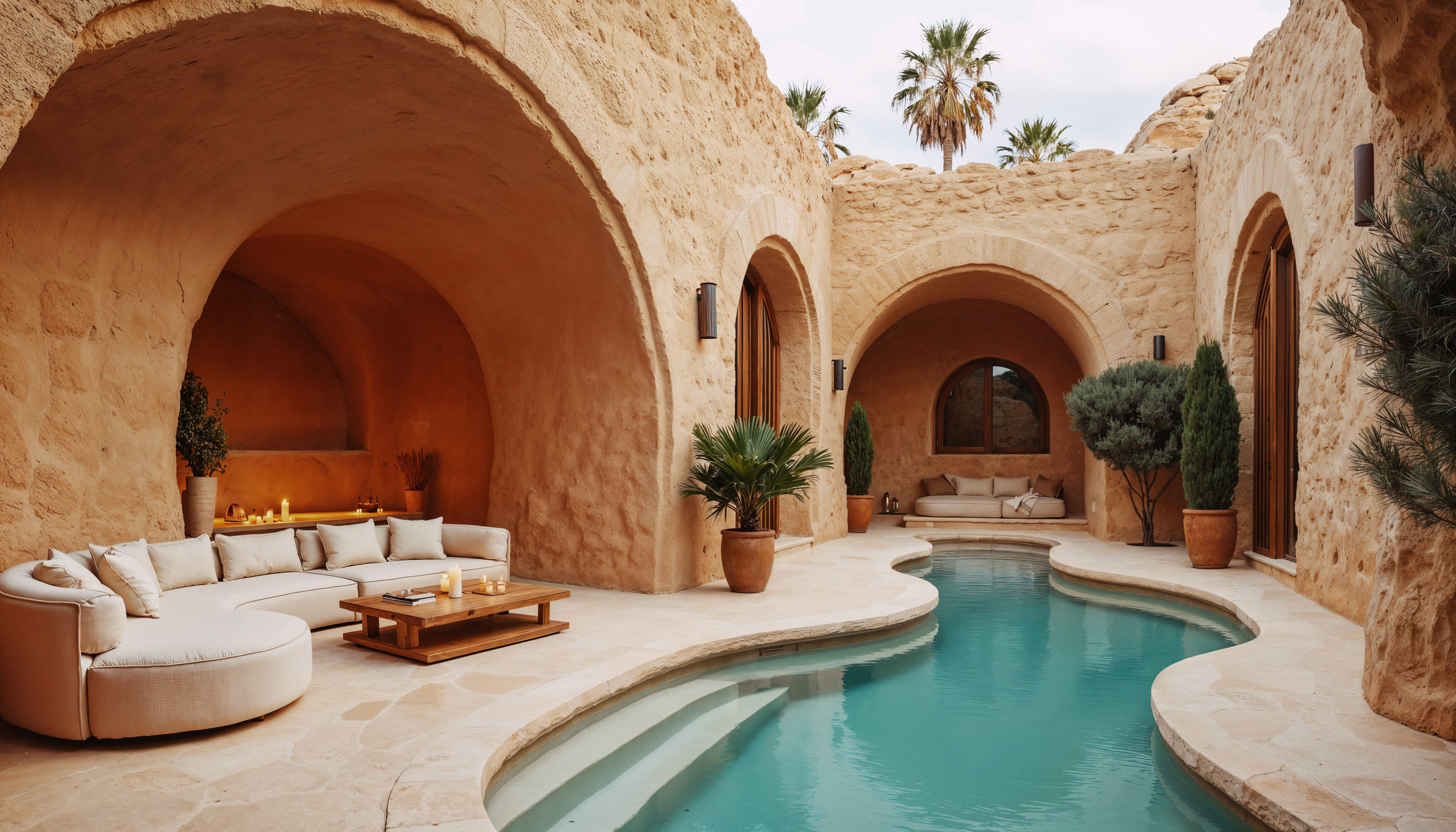
Short-term rental platforms have fundamentally changed the investment calculus for Marrakech property. What was once the domain of boutique hoteliers is now accessible to individual investors who want strong, recurring returns from one of North Africa's most visited cities. This guide covers everything you need: market data, yield benchmarks by neighborhood, operating cost structures, legal obligations, and a worked financial model so you can evaluate any property with confidence.
The Numbers: Marrakech Airbnb Market at a Glance
Marrakech has established itself as one of the most active Airbnb markets in the Middle East and Africa. The platform data tells a compelling story for investors considering entry into the market.
- 9,600+ active Airbnb listings across the city and surrounding areas
- Average annual occupancy: 64% — well above the global average for comparable cities
- Average daily rate: MAD 850/night (approximately €78), rising sharply in prime neighborhoods
- Average annual host revenue: MAD 192,000 (~€17,500) before operating costs
- Entire-home listings account for 75.8% of total inventory
The sustained demand comes from multiple traveller segments: European city-breakers (weekend to one-week trips), cultural tourists, high-end honeymooners, and an increasing number of digital nomads who stay for several weeks at a time. This diversity of demand smooths out the revenue curve and protects against single-segment shocks.
| City | Avg. Airbnb Yield | Avg. Daily Rate (EUR) | Annual Occupancy |
|---|---|---|---|
| Marrakech | 8–14% | €78–€220 | 64% |
| Paris | 3% | €120–€280 | 55% |
| Lisbon | 4–5% | €90–€160 | 58% |
| Barcelona | 4–6% | €100–€200 | 62% |
The comparison is striking. Despite Marrakech's lower average daily rate in euro terms, the significantly lower acquisition cost per square metre means yields are dramatically higher than in Western European cities where property is priced at a premium.
Rental Yield by Neighborhood
Not all parts of Marrakech perform equally on short-term rental platforms. Location, property type, and proximity to key attractions each play a role in determining both nightly rate and occupancy. Below is a breakdown of expected gross yields by area.
| Neighborhood | Property Type | Gross STR Yield | Notes |
|---|---|---|---|
| Medina | Riad (3–6 rooms) | 11–14% | Highest demand, premium nightly rates |
| Guéliz | Apartment (1–3BR) | 8–12% | Year-round demand, business travellers |
| Hivernage | Apartment / Small villa | 8–10% | Upscale clientele, walking distance to Jemaa El Fna |
| Palmeraie | Villa (4–8BR) | 8–12% | Premium nightly rate offsets lower occupancy |
| Targa | Entry-level apartment | 10–14% | Lower acquisition cost drives yield; rising demand |
For context, equivalent short-term rental yields in Paris sit around 3%, Lisbon at 4–5%, and Barcelona at 4–6% — markets where regulatory crackdowns have further constrained supply and compressed returns for new investors.
Marrakech delivers 2–3x the rental yield of most Western European investment markets, with a property acquisition cost that is 3–5x lower per square metre than Paris or Barcelona. This combination produces a compelling risk-adjusted return profile for investors entering today.
Riad vs Villa vs Apartment: Which Wins on Airbnb?
Each property type attracts a distinct traveller profile and comes with its own operational characteristics. Understanding this is essential before committing capital.
Full homes dominate the platform: 75.8% of Marrakech Airbnb listings are entire homes, reflecting that travellers booking the city prefer privacy and an immersive experience. Shared rooms and private rooms in larger properties represent a small fraction of both listings and revenue.
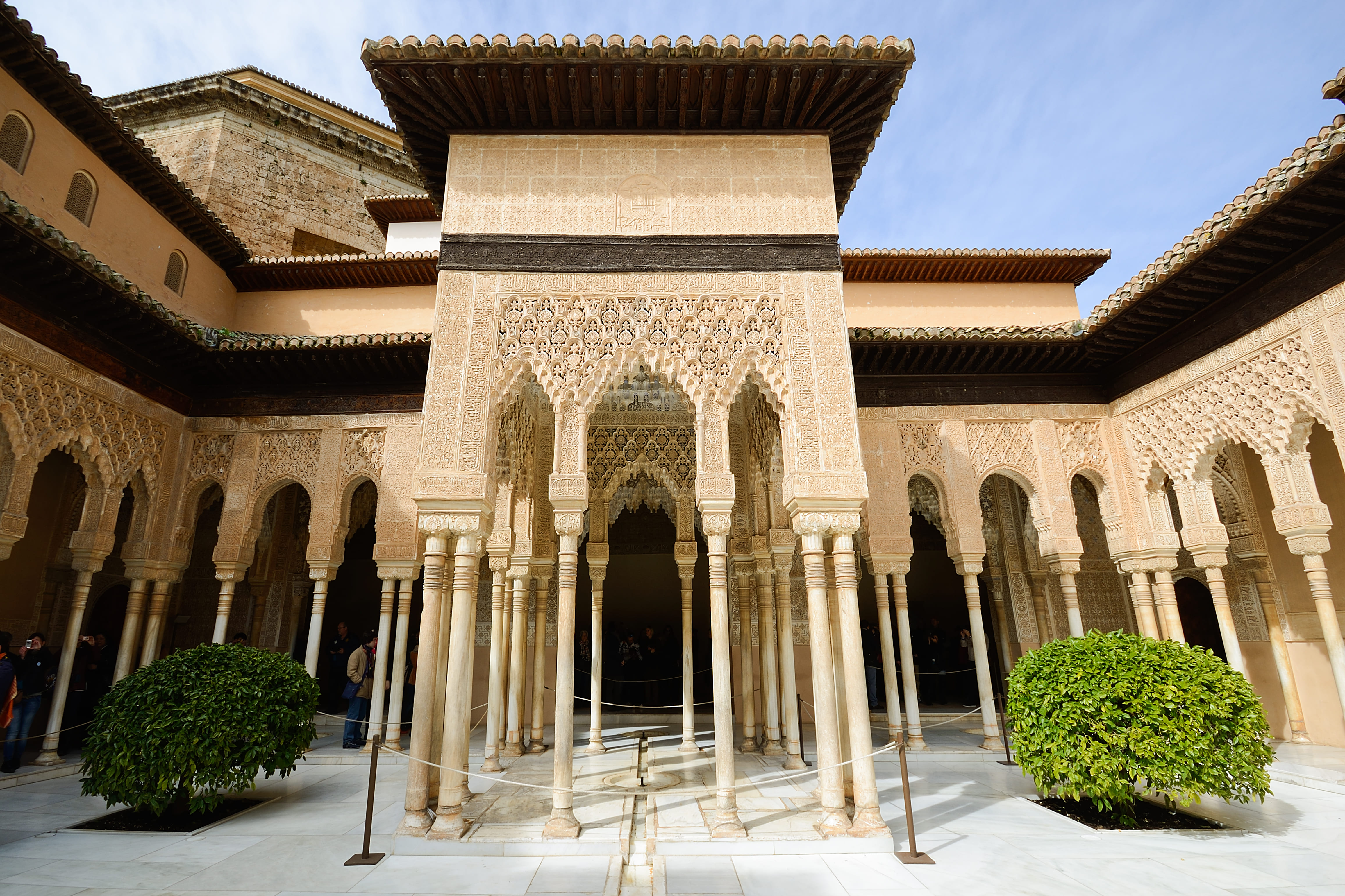
Riads command the highest nightly rates of any property type in the city. A well-renovated, well-photographed full riad with 4–6 rooms in the Medina can achieve €100–€600/night depending on season and group size. The architectural uniqueness — zellige tiles, central courtyard, rooftop terrace — creates a premium that no modern apartment can replicate. The trade-off is higher renovation and management overhead.
Apartments in Guéliz and Hivernage offer lower management complexity and more consistent year-round demand from business travellers, solo tourists and couples. Nightly rates are lower (MAD 400–900 for a well-positioned 1–2BR), but acquisition costs are also lower, and occupancy tends to be more stable across seasons.
Villas in the Palmeraie and along the Route de l'Ourika represent the highest absolute revenue ceiling. A 5–6 bedroom villa with a pool, garden and staff can command €600–€2,000/night during peak season. However, this comes at the cost of higher acquisition prices, substantial ongoing maintenance (pool, garden, full-time staff), and lower year-round occupancy given the group-travel demand pattern.
- Highest gross yield: 11–14% in prime Medina locations
- Full-riad nightly rate: €100–€600/night
- Unique architectural appeal drives premium pricing
- Can be licensed as a maison d'hôtes for commercial operation
- Requires on-site staff and proactive maintenance
- Higher renovation cost if acquiring unrestored property
- No car access — affects certain guest demographics
- Villa yield: 8–12%; Apartment yield: 8–12%
- Villa nightly rates: €300–€2,000/night (group market)
- Apartments: consistent year-round demand, easier to manage
- Modern amenities and car access broaden guest appeal
- Lower renovation and refurbishment risk on new builds
- Villas carry high running costs (pool, garden, staff)
- Apartments: lower overhead, suitable for remote management
Seasonality: When Occupancy is Highest
One of Marrakech's key advantages for short-term rental investors is the length of its high season. Unlike southern European resorts, which peak for 8–10 weeks and then struggle through winter, Marrakech sustains strong demand for approximately eight months of the year.
High season (October through May) delivers occupancy rates of 75–90% in prime areas. The climate during this period — warm days, cool nights, no extreme heat — is near-ideal for tourism. Festivals and cultural events throughout this window generate demand spikes: the Marrakech International Film Festival in November, New Year periods, and the spring festival season in March and April are all consistent occupancy drivers.
Peak months: December–January and March–April. European travellers escaping winter fill the city in December and January. Spring, with temperatures in the low-to-mid 20s and the vibrant atmosphere of festivals and gardens in bloom, is arguably the most photogenic and sought-after period.
Summer (June through August) represents the softer part of the calendar. Temperatures regularly exceed 38°C, deterring sun-sensitive European visitors. However, occupancy still averages 65–70%, partly sustained by Moroccan domestic tourism, Gulf travellers seeking cultural experiences, and visitors who specifically choose to come in the quieter, cheaper period. This is substantially better than the low-season trough experienced by comparable Mediterranean investment markets.
FIFA World Cup 2030 is a significant medium-term catalyst. Morocco is a co-host, with several matches expected to be played in Marrakech. Analysts project rental premiums of 50–70% during tournament weeks, potentially generating in a single month what would normally take three months to achieve. Properties acquired today stand to benefit from this structural demand event.
Morocco's Short-Term Rental Rules: What Every Host Must Know
The legal framework for short-term rentals in Morocco is more structured than in some comparable emerging markets, which is ultimately positive for investors as it provides a degree of regulatory clarity. However, compliance is not optional, and hosts who operate without proper registration risk fines and forced closure.
Law 80.14 governs tourism accommodation in Morocco. Any property operating commercially as a short-term rental is considered a tourism establishment and must comply with classification requirements. This is particularly relevant for riads operating as maisons d'hôtes, which are a recognised and specifically regulated category under Moroccan tourism law.
Ministry of Tourism registration is required for maisons d'hôtes and guesthouses wishing to advertise commercially and operate legally. The registration process involves a property inspection and documentation of the owner's identity and the property's compliance with basic health and safety requirements.
Police guest registration is mandatory within 24 hours of a guest's arrival. Hosts must submit a fiche d'hébergement — a guest registration form — to the local police. This is a standard requirement across all Moroccan accommodation providers, from large hotels to private rentals. Property management companies handle this automatically as part of their standard service.
Income tax declaration must be filed with the Direction Générale des Impôts. Rental income from short-term lets is subject to Moroccan income tax. Non-resident investors are subject to a flat withholding rate; resident investors are taxed under the standard progressive scale. Rental income must be declared annually, and property management companies typically provide year-end revenue summaries to facilitate this.
OMNIA BUSINESS works with local lawyers who specialise in short-term rental compliance and tourism licensing. Whether you are purchasing a riad that requires maison d'hôtes classification or an apartment for standard Airbnb operation, we can connect you with the right advisors to ensure your investment is structured correctly from day one.
Real Operating Costs: What Eats Into Your Yield
Gross yields are the headline figure, but net yield — what reaches you after all operating costs — is what matters. Below is a realistic cost structure for a short-term rental property in Marrakech.
- Property management fees: 20–25% of rental revenue. This covers guest communication, check-in and check-out, cleaning coordination, minor maintenance and police registration. For remote investors, this is a necessary cost.
- Platform fees (Airbnb / Booking.com): 3–15% depending on the pricing model chosen. Airbnb's host-only fee structure charges approximately 3%, while split-fee models can result in a higher effective cost. Direct bookings through Booking.com carry a 15% commission.
- Cleaning and linen turnover: MAD 200–600 per turnover depending on property size. A riad with frequent short stays can generate significant annual cleaning costs.
- Maintenance reserve: MAD 5,000–20,000/year depending on property type, age, and condition. Older Medina riads sit at the higher end; newer apartments are at the lower end.
- Pool and garden maintenance (villas): MAD 15,000–40,000/year for regular pool servicing, chemical treatment, and garden upkeep. This cost is unavoidable for any villa marketed with outdoor amenities.
- Utilities (where not passed to guests): Water, electricity and WiFi for a standard apartment run MAD 400–800/month. Larger properties are proportionally higher.
Worked Example: 4-Room Medina Riad
To illustrate how these costs stack up in practice, here is a realistic model for a 4-room riad in a good Medina location, listed at €250/night as a full-riad booking.
| Item | Assumption | Annual Figure |
|---|---|---|
| Nightly rate | €250 average (blended) | — |
| Occupancy rate | 65% (237 nights) | — |
| Gross Revenue | 237 × €250 | €59,250 |
| Platform fees (3%) | Airbnb host-only | −€1,778 |
| Property management (22%) | Of gross revenue | −€13,035 |
| Cleaning / linen (MAD 500 avg × 237) | MAD 118,500 (~€10,800) | −€10,800 |
| Maintenance reserve | MAD 15,000 (~€1,365) | −€1,365 |
| Utilities (full-year estimate) | MAD 9,600 (~€875) | −€875 |
| Net Revenue | €31,397 | |
| Assumed acquisition price (renovated riad) | €280,000 | |
| Net Yield | 11.2% | |
This model demonstrates that even after accounting for all realistic operating costs, a well-chosen and well-managed riad can deliver a net yield in excess of 11% — a figure that would be exceptional in any Western European market.
Frequently Asked Questions
Ready to Find Your Marrakech Investment Property?
At OMNIA BUSINESS, we specialise in identifying high-yield short-term rental properties in Marrakech before they reach the open market. Our team combines deep local knowledge with a rigorous financial approach — we can model expected returns for any specific property you are considering, and introduce you to trusted lawyers, management companies, and notaries. Browse our current investment listings or message us directly on WhatsApp to discuss your goals.